For almost 70 years, Bouygues Immobilier has been designing living spaces, whether individual homes, neighbourhoods or entire towns, that are adapted to all types of urban environment.
Bouygues Immobilier is a full-range property developer that addresses three priorities: the needs of its customers, the expectations of local authorities and current environmental concerns.
Capitalise on its local in-depth knowledge to address its stakeholders’ expectations.
Its growth strategy is based on:
- a local presence, with teams in 32 branches across France;
- its “Coeur de vie” solution that provides more sustainable, modular and comfortable homes;
- solutions that help bring nature back into urban environments.
This strategy revolves around four priorities :
- strengthen the position in the Paris region, an area that represents a major growth driver for the company;
- target high-potential regions: such as French border regions experiencing strong economic activity, conurbations with high population growth, tourist regions, areas subject to reindustrialisation policy with major projects under development;
- regenerate urban environments, focusing on suburban areas, vacant industrial land and the property assets of major institutional landlords;
- turn office stock that is ill-suited to new work practices into housing or other multi-product assets.
Offer more sustainable products that promote well-being in urban environments
Backed by over ten years of experience in energy efficiency, Bouygues Immobilier assesses all its property developments and services from the angle of carbon performance and their ability to adjust to the climate emergency. Bouygues Immobilier’s medium- (2030) and long-term (2050) decarbonisation targets have been endorsed by SBTi (Science Based Targets initiative). These targets are consistent with the Paris Agreement’s aim of limiting global warming to 1.5°C.
The decarbonisation of Bouygues Immobilier’s products and services will entail:
- low-carbon construction. Going beyond what is required by existing regulations by promoting low-carbon building methods and local materials, particularly bio-based and geo-based materials;
- preserving existing spaces by increasing rehabilitation, conversion and selective deconstruction with reuse of materials;
- reducing user carbon footprints, backed by the roll-out of a calculator developed specifically to assess the overall carbon footprint of a neighbourhood and its inhabitants, from the design stage.
Bouygues Immobilier is also working hard to encourage biodiversity through three flagship initiatives, which it applies systematically across all projects:
- conduct a preliminary environmental assessment for all project sites;
- set a minimum target biotope area factor for all projects, from the design stage, in order to maximise the extent of biodiversity-favourable spaces;
- integrate the design specifications for its signature garden concept in all its property developments that include an outdoor space.
Decarbonisation and measures to protect biodiversity are factored into all Bouygues Immobilier products, from housing and commercial property to hotels and neighbourhoods.
Operational priorities
- Address all housing needs, whether social housing, intermediate rental housing, managed housing or homes for owner-occupiers.
- Strengthen regional roots and gain market share amid a weakened environment.
- Reduce the carbon footprint of operations and adapt property developments to the challenges of the climate emergency, by increasing the share of green spaces that maximise nature in urban environments.
2024 key figures
- €1.5bn Sales
- € 0.9 bn Backlog
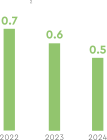
Greenhouse gas emissions a
Mt of CO2 eq.
100 % of employees trained in low-carbon design in 2024
(a) All scopes
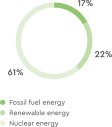
Split of energy use in 2024
%