
Building infrastructure for a low-carbon society and developing innovative low-carbon solutions
Bouygues Construction enjoys broad expertise in developing the critical infrastructure necessary to build community resilience and to make the green and energy transition a reality from low-carbon and renewable energy generation systems (nuclear, offshore wind and solar) to public and EV transport networks, urban renewal and regeneration projects, and sustainable residential, commercial and industrial buildings.
Bouygues Construction is pursuing a range of initiatives in its drive to decarbonise its businesses. As well as reducing material volumes by embracing eco-design, it also uses recycled steel, low-carbon concrete, and bio-based and geo-based materials. Meanwhile, through its WeWood approach, it is targeting timber-based construction methods for 30% of its building projects by 2030. It has also created Cyneo, a platform for re-use of materials, and is making significant efforts to reduce waste at its worksites.
Alongside these measures, Bouygues Construction is catering to market demand with dedicated products and services. Examples include Coréha for large-scale housing renovation, Cyclic for reversible and multi-use buildings, and Archisobre, a building concept that reduces the carbon footprint of commercial properties by a factor of three. And in keeping with its “build differently” philosophy, it is shifting to mass-scale, digital technology-powered production methods with a focus on optimising design and using prefabricated structures.
 CLIMATE SOLUTION
It was agreed with the architects to use wood for the entire framework and roof of the pool hall. The glass facades, lined with external sunshades, are made of wood. The Aquatics Centre was made with over 1,200 tonnes of bio-based materials (71 kg per m² of floor area). Its bio-climatic design reduces energy use and the carbon footprint. For example, the concave line of the roof optimises the heated volume. The sports hall, with its huge volume, is the jewel in the complex’s crown. The roof is able to host photovoltaic panels, making the building one of the largest urban solar farms in France. It can capture solar energy via its 4,680-m² photovoltaic power station, which is consumed entirely on site, mainly to power the water treatment system pumps.
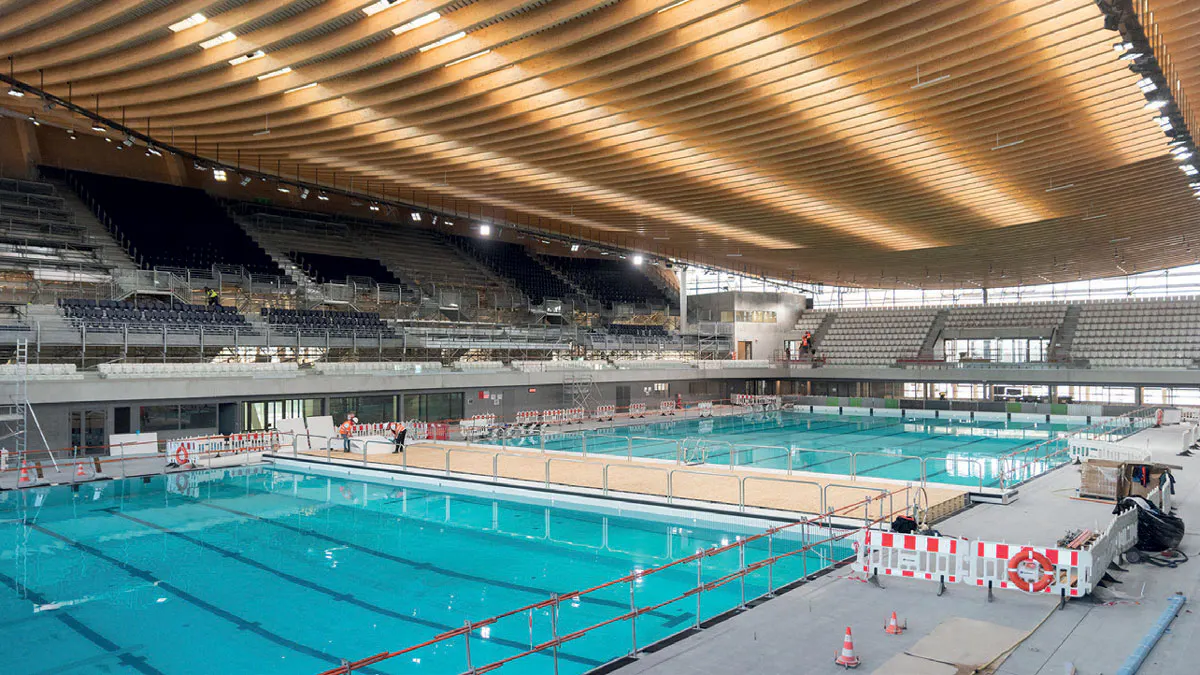
FRANCE – The Saint-Denis Aquatics Centre, built by Bouygues Bâtiment Île-de-France, has a concave timber frame made up of 90 curved catenary beams, each 55 cm thick and spanning 90 metres. A timber-frame construction record!
Progress on sustainable solutions
- Roll-out of a carbon management cycle
- Launch of the “Agir pour la Biodiversité” biodiversity-focused training module and the “Audace Environnementale” environmental initiative at Bouygues Bâtiment France
- Award of the Responsible Supplier Relations & Purchasing label (France scope)
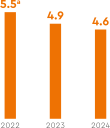
Greenhouse gas emissions
Mt of CO2 eq.
91 % of worksites have the Topsite label (for compliance with internal CSR standards)
Split of energy use in 2024
%
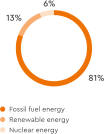
(a) All scopes and on a constant scope basis, 2022 data restated after excluding Bouygues Energies & Services.