
Strategy
The Group’s integrated sustainability approach
The Bouygues group is spearheaded by the parent company, Bouygues SA, which defines the strategic framework to be followed by the business segments, taking their distinctive features into account.
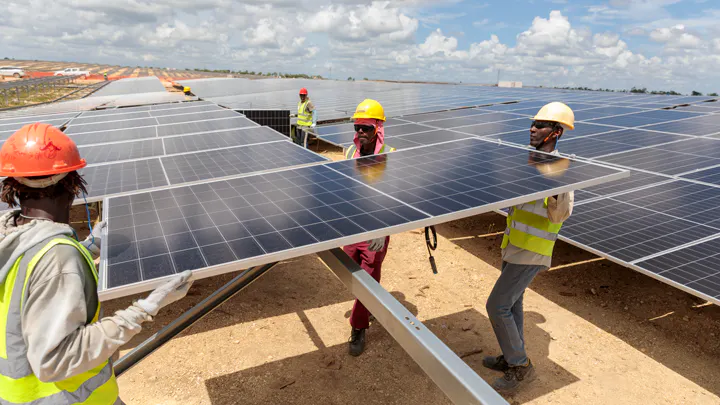

DOMINICAN REPUBLIC – Equans Solar & Storage is building several solar farms in the Caribbean nation.
The business segments use this overarching framework to set sustainability targets for all the geographies in which they operate, taking into account the specifics of their business activities and organisational structures, as well as the constraints they face.
Colas has integrated climate change issues into its strategy. As well as continuing to take steps to cut its direct emissions (such as switching to hybrid vehicles and LNG-powered bitumen tankers), it is working to promote low-carbon methods and solutions (cold-mix technologies, low-carbon concrete and cement, etc.), help its customers reduce their carbon footprint, and protect biodiversity, including through its environmental engineering services.
Bouygues Construction aims to strike a balance between growth and sustainability, even in countries where decarbonisation efforts are at a less advanced stage. It does so by constructing low-carbon energy production and public transport infrastructure, building and renovating buildings and neighbourhoods, sourcing lower-carbon materials through partnerships with innovative suppliers, developing circular models and optimising the design of its structures.
Bouygues Immobilier’s goal is to proactively embed climate-change adaptation and mitigation into its products and services while staying ahead of regulatory changes. As part of this strategy, it has rolled out an ambitious policy of bringing nature into urban environments across its property developments, along with a forward-thinking circularity policy.
Equans is aiming to accelerate its customers’ shift to a resilient, low-carbon future, including through its “Our Planet” action plan. A leading player in the energy, digital and industrial transitions, it offers an extensive range of sustainability-focused products and services. The action plan also includes measures to develop circularity and protect biodiversity.
Bouygues Telecom is determined to play its part in shaping a more responsible digital future by helping its customers navigate the technology landscape. At the same time, it is taking steps to continue shrinking its environmental footprint, such as by optimising the life cycle of the equipment it uses and the products it sells, switching to more energy-efficient infrastructure, and rolling out eco-design approaches with its suppliers.
TF1’s goals are four-fold: to keep television viewers informed and aware of social and environmental challenges (gender equality, diversity, the green transition, etc.), to promote CSR-compatible messages in the advertising it broadcasts, to gradually roll out eco-production practices in-house, and to help its production partners make headway on these issues.
On the human resources front, the Group has the following objectives, as set out in its “People First” action plan (p.34–35):
- ensure the health, safety and well-being of all employees.
- hire and onboard employees and advance their careers.
- provide an inclusive and welcoming working environment.
- base labour relations on constant and constructive dialogue, including listening to and working with employee representative bodies, implementing agreements and conducting engagement surveys (see p.10).
- ensure that human rights are protected (see p. 33).
In terms of social responsibility, the Group’s goals are as follows:
- endeavour to meet the highest standards of ethical business conduct (see p. 12-13).
- forge trust-based relationships with suppliers and subcontractors and engage in dialogue with stakeholders.
- ensure that human rights are protected all along the value chain (see p. 33).
- support the economic development of the geographies in which the Group operates.
On the environmental front, the Group aims to contribute to the green and energy transitions in three ways:
- fight climate change by rolling out new products and services to help customers reduce their environmental impact, and by pledging to cut its own greenhouse gas emissions (see p. 39 and 41-55).
- help preserve resources by rolling out products and services based on circular-economy methods, and by working to shrink its own resource footprint.
- protect biodiversity.